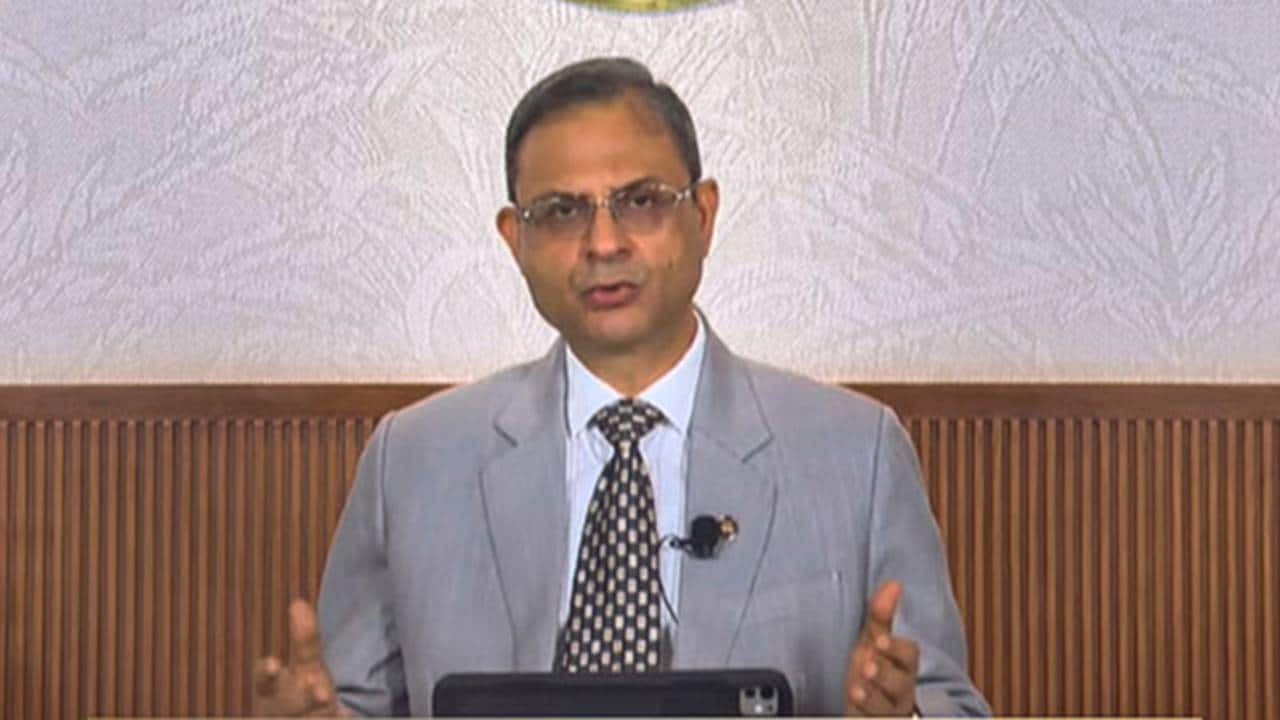
Policy rates likely to stay same or go lower: RBI Governor Sanjay Malhotra
March 02, 2026
Malhotra, who has completed an year as RBI governor, said India's macroeconomic fundamentals continue to remain healthy and robust.
Ahead of the conflict in West Asia, Reserve Bank of India (RBI) governor Sanjay Malhotra said policy rates are likely to stay at current levels or even go lower even as he cautioned about global uncertainty, climate risk and technology disruptions.
In an interview with the Economic Times, on being asked if the outlook towards growth and inflation has changed given the change in tariff assumptions, Malhotra said the RBI will be giving full-year projections of growth and inflation in the next policy in view of the forthcoming revision in the base year and methodology.
"We have not yet finalised numbers for the next year. We are still analysing the impact of the changes. Our analysis will also account for the impact of changes in tariffs," he said.
Malhotra said India's macroeconomic fundamentals have improved over the years-- from a sub-6% growth in the 80's and 90's to 6.6% in the last decade and 7.3% during FY24-FY26, as per the new series.
"Similarly, if you look at inflation, it used to be very high in the 80s and 90s. In the nine years preceding inflation targeting, the average headline inflation was 6.9%. In the subsequent nine years, however, it was 4.9%," said the RBI Govenor.
"Health of corporates, banks, governments, private sector are all much better. That gives me confidence that in the short, medium, and long run, our macroeconomic fundamentals will continue to remain healthy and robust," he said.
Listing geopolitical tensions, geoeconomic uncertainties, and climate-related events as the downside risks, Malhotra said, "A large part of our population still relies on a monsoon-dependent agrarian economy. And then, technology disruptions...However, we expect the policy rate to be around this level or lower for a long time, barring any shocks."
"It will depend on growth-inflation dynamics as they play out. We are still living in very uncertain times. We will assess it meeting by meeting based on incoming data," said the RBI Governor.
On why foreign and private investments are lagging behind despite growth numbers being strong, Malhotra said investment has picked up, especially gross foreign direct investment (FDI) which grew about 13 per cent last year.
"It is only net FDI which has not been growing as much, not because gross FDI is not increasing, but because repatriations and overseas direct investments have increased in the last two years. This is organic and healthy. Our macroeconomic fundamentals are robust. There are investment opportunities abroad; therefore, increase in overseas direct investments is to be expected. The repatriations also tend to occur as per investment cycles," he said.
On being asked if India is by the anti-AI trade, the RBI Governor said FIIs have relatively shorter investment horizons and though investments have moved towards countries with AI opportunities, it has nothing to do with India's macroeconomic fundamentals.
"India too is investing in all five layers of AI-energy, chips, infrastructure, LLMs and applications-and AI adoption is also rising. India will certainly be part of this AI story as evident from the AI summit held recently," he said.
On the question of whether forex reserves will be able to cover external liabilities, Malhotra said, "Our macroeconomic fundamentals remain strong. Our forex reserves can cover current account deficits over decades. Several FTAs have been signed and some are in the pipeline. That will help the current account and also the capital account by bringing investments into India."
"Over $250 billion of investment pledges have been made during the AI summit. Earlier, $67.5 billion was committed by tech giants. The government has liberalised the insurance sector to allow 100% FDI," he said.
To a question of whether rupee will remain steady at current levels after a period of depreciation, the RBI governor said that the the level of rupee is determined by demand and supply of foreign exchange. "As per historical trends, the rupee has generally strengthened in the last quarter of a financial year. I would also like to emphasise that we do not target any levels. We only aim to curb any excessive volatility either way," said Malhotra as quoted by Economic Times.
Malhotra, who has completed an year as RBI governor, said that there is room for more improvement. "As someone famously said, and I will quote, "The job of the central bank is to worry." We have to continuously be alert to all those risks, whether it is geopolitics, climate, technology or cyber security," he said.
On being asked that if there's anything more that he would like to implement or complete any unfinished agenda, the RBI Governor said, "It is a continuous effort to strengthen the banking system, promote ease of doing business, improve financial inclusion and enhance customer centricity. At the same time, maintaining financial and price stability continues to be the guiding principle. Other areas which we are working on include increasing the safety and security of payment systems and enhancing convenience in forex management."
In an interview with the Economic Times, on being asked if the outlook towards growth and inflation has changed given the change in tariff assumptions, Malhotra said the RBI will be giving full-year projections of growth and inflation in the next policy in view of the forthcoming revision in the base year and methodology.
"We have not yet finalised numbers for the next year. We are still analysing the impact of the changes. Our analysis will also account for the impact of changes in tariffs," he said.
Malhotra said India's macroeconomic fundamentals have improved over the years-- from a sub-6% growth in the 80's and 90's to 6.6% in the last decade and 7.3% during FY24-FY26, as per the new series.
"Similarly, if you look at inflation, it used to be very high in the 80s and 90s. In the nine years preceding inflation targeting, the average headline inflation was 6.9%. In the subsequent nine years, however, it was 4.9%," said the RBI Govenor.
"Health of corporates, banks, governments, private sector are all much better. That gives me confidence that in the short, medium, and long run, our macroeconomic fundamentals will continue to remain healthy and robust," he said.
Listing geopolitical tensions, geoeconomic uncertainties, and climate-related events as the downside risks, Malhotra said, "A large part of our population still relies on a monsoon-dependent agrarian economy. And then, technology disruptions...However, we expect the policy rate to be around this level or lower for a long time, barring any shocks."
"It will depend on growth-inflation dynamics as they play out. We are still living in very uncertain times. We will assess it meeting by meeting based on incoming data," said the RBI Governor.
On why foreign and private investments are lagging behind despite growth numbers being strong, Malhotra said investment has picked up, especially gross foreign direct investment (FDI) which grew about 13 per cent last year.
"It is only net FDI which has not been growing as much, not because gross FDI is not increasing, but because repatriations and overseas direct investments have increased in the last two years. This is organic and healthy. Our macroeconomic fundamentals are robust. There are investment opportunities abroad; therefore, increase in overseas direct investments is to be expected. The repatriations also tend to occur as per investment cycles," he said.
On being asked if India is by the anti-AI trade, the RBI Governor said FIIs have relatively shorter investment horizons and though investments have moved towards countries with AI opportunities, it has nothing to do with India's macroeconomic fundamentals.
"India too is investing in all five layers of AI-energy, chips, infrastructure, LLMs and applications-and AI adoption is also rising. India will certainly be part of this AI story as evident from the AI summit held recently," he said.
On the question of whether forex reserves will be able to cover external liabilities, Malhotra said, "Our macroeconomic fundamentals remain strong. Our forex reserves can cover current account deficits over decades. Several FTAs have been signed and some are in the pipeline. That will help the current account and also the capital account by bringing investments into India."
"Over $250 billion of investment pledges have been made during the AI summit. Earlier, $67.5 billion was committed by tech giants. The government has liberalised the insurance sector to allow 100% FDI," he said.
To a question of whether rupee will remain steady at current levels after a period of depreciation, the RBI governor said that the the level of rupee is determined by demand and supply of foreign exchange. "As per historical trends, the rupee has generally strengthened in the last quarter of a financial year. I would also like to emphasise that we do not target any levels. We only aim to curb any excessive volatility either way," said Malhotra as quoted by Economic Times.
Malhotra, who has completed an year as RBI governor, said that there is room for more improvement. "As someone famously said, and I will quote, "The job of the central bank is to worry." We have to continuously be alert to all those risks, whether it is geopolitics, climate, technology or cyber security," he said.
On being asked that if there's anything more that he would like to implement or complete any unfinished agenda, the RBI Governor said, "It is a continuous effort to strengthen the banking system, promote ease of doing business, improve financial inclusion and enhance customer centricity. At the same time, maintaining financial and price stability continues to be the guiding principle. Other areas which we are working on include increasing the safety and security of payment systems and enhancing convenience in forex management."